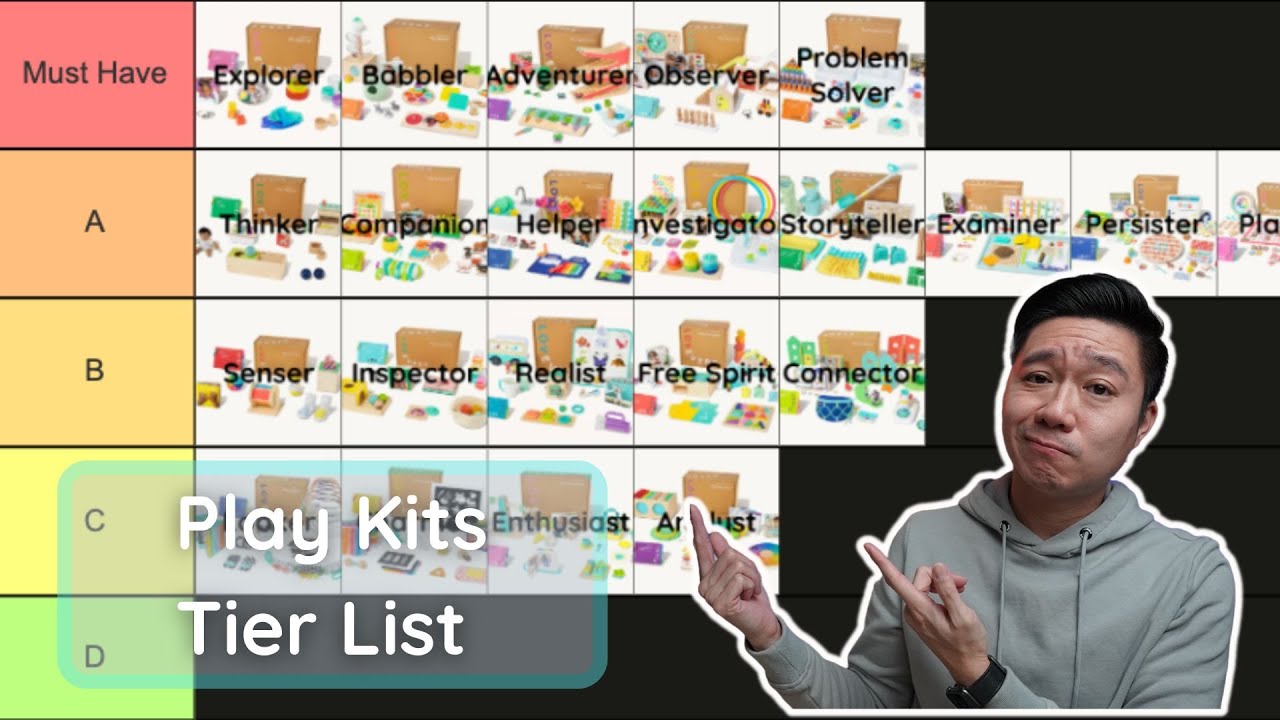
I Ranked Every Lovevery Play Kit: Which Are Must-Haves?
After about four and a half years of owning Lovevery play kits across two kids, I finally ranked every single one against the others. A quick note before the list: this is relative ranking. A kit landing lower doesn’t mean it isn’t worth the money — in my review videos I’ve shown that the value is there in pretty much every kit. Think of these tiers as a guide for parents who don’t want to subscribe to every stage and are deciding where to spend.
I used five tiers — Must-Have, A, B, C, and D — weighted heavily toward two things: longevity (how long the items actually stay in rotation) and uniqueness (how hard the items are to replace with something cheaper). And no two kids are the same — my son loved things my daughter ignored, and vice versa, so your mileage will vary.
Which Lovevery Kits Are Best for Babies (0–12 Months)?
The earliest kits are tailored to a narrow age window, so a few of them naturally have shorter shelf lives.
- The Looker (C) and The Charmer (C) are both great for their moment — high-contrast visuals and the play guide — but nothing beyond that carries forward for long.
- The Senser (B) earns its spot on the strength of the tissue box and spinning rainbow. The tissue box alone bought us countless hours of tummy time and is one of the most memorable items of this whole age range.
- The Inspector (B) comes with the drip drop cups, which my kids used in the bath and for backyard water play for years — genuinely better than every other brand of stacking cup we’ve tried. It would have been an A, but since you can now buy the cups standalone at Target, the kit as a whole drops to a solid B.
- The Thinker (A) is loaded — the wooden peg drop, the organic cotton doll, the sensory switchboard. The older “Avery” doll design my kids adored might have pushed it into Must-Have; the newer dolls are good but didn’t grab them the same way.
- The Explorer (Must-Have) is the best 0–12 month kit, full stop. The grip canister sets, clear tubes, and stacking rings were a hit long after the novelty wore off — my four-year-old still plays with the light-and-bright items.
What’s Best for Toddlers (Year One Kits)?
Year One is where the books level up — real photographic images the kids love — and where a couple of kits become easy Must-Haves.
- The Babbler (Must-Have) has the famous ball run that both a two- and four-year-old still play with, plus Bedtime for Zoe, which is perfect for the stage when bedtime becomes a fight.
- The Adventurer (Must-Have) was a slow burn — neither kid cared for the race-and-chase ramp at first, but both love it now. The threadable beat activity and the stackable wooden peg (my favorite item — it stacks high and doesn’t topple) push it over the line.
- The Realist (B) brings things back down slightly. The flashlight is sized well for small hands and the lock box is endlessly engaging, but it lacks a wild-factor item.
- The Companion (A) shines thanks to the mosaic button board (I still rotate ours back in) and the animal match — kids don’t outgrow animal figurines for a long time.
Are the Year Two Kits Worth It?
This is where a lot of parents drop off as kids develop their own interests — but the teaching items here are some of the best.
- The Helper (A−) is anchored by the water-play sink (nearly universal kid appeal), plus the drop-and-match thought catcher and the routine cards, which help kids visualize their day.
- The Enthusiast (C) has a couple of standouts — the perfectly-tensioned spray bottle and squeegee, and the My Favorite Nature Buddy book — but the rest of the kit doesn’t hold up.
- The Researcher (A) is deep: the liquid lab and its water-containment base, a color-coded countdown timer you can actually see coming, the match-and-tap hammer box, and the Playday book.
- The Free Spirit (B) centers on the wooden counting box (good for a solid year of counting practice), the wooden camper, and the two-part puzzle board.
How Good Are the Year Three Kits (Preschool)?
Year Three is where the planning and feelings tools start to earn their keep.
- The Observer (Must-Have) comes with three books that teach different feelings — still among my son’s favorites — plus the plan-ahead weatherboard, which quietly fixed our morning struggles by letting the kids see whether tomorrow is a school day or a home day. The modern playhouse is a hit too. My only gripe: the left/right shoe stickers don’t come with enough refills.
- The Storyteller (A−) offers real fun with the modular fort and puppet theater, but the most-used item is the squeeze-and-spray mop — there’s nothing else quite like it made for a toddler.
- The Problem Solver (Must-Have) is one of my favorites: the Montessori math bars and number tiles make counting (and later addition and subtraction) genuinely fun and last for years, the turtle hatch game is a great cooperative first game, and the liquid color lab teaches color mixing.
- The Analyst (C) is the weakest of the group — nothing bad in it, just not as memorable next to the others.
Are the Year Four Kits Still Universal?
By age four, kids’ interests really diverge, so it’s impressive Lovevery keeps these broadly useful.
- The Connector (B) earns its spot on the Inventor Adventure Pack (perfectly sized for taking activities on the go) and the daily helper board for building routines.
- The Examiner (A) continues the planning theme with the plan-ahead headboard — my son’s favorite for knowing his week in advance — plus rhyming rings and the “appropriate” game book, which makes a genuinely hard concept teachable.
- The Persister (A) looks like a strong literacy kit — three of its activities revolve around letters and sounds — plus the calming circle for big feelings and a path-building marble maze. It could climb to Must-Have as my son grows into it.
- The Planner (A) adds a matching mini clock for learning to tell time, a wooden ball ramp, and dominoes — but the item I’m most excited about is the Rover Route, a screen-free pre-coding game that teaches coding concepts without a robot or electronics getting in the way.
The Final Verdict: Which Lovevery Kits Are the True Must-Haves?
Across four and a half years, the kits that stood out for lasting value were The Explorer (0–12 months), The Babbler and The Adventurer (Year One), and The Observer and The Problem Solver (Year Three). But remember the framing: even the C-tier kits deliver real value — these tiers are about where to start, not what to avoid. If you’d rank them differently, I’d genuinely love to hear it.
Disclaimer: Some of the links below are affiliate links, meaning I may earn a small commission at no extra cost to you if you decide to purchase.
Where to buy
Some links on this page are affiliate links — I may earn a small commission at no extra cost to you.